

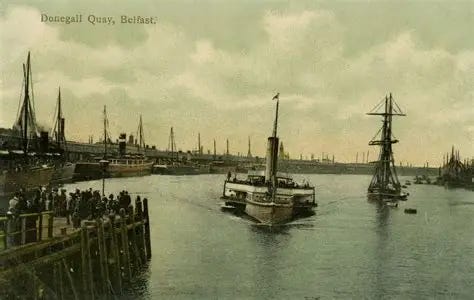
On an evening in September of 1908, less than two weeks after the death of his mother Flora, C.S. Lewis, known to his family as Jack, was off to school. In his memoirs, he recalls the clop-clop-clop of the horsedrawn carriage rattling over the uneven Belfast streets. The silence of his brother Warnie, by now a veteran of the sufferings of a schoolboy, as the carriage rolled along. The discomfort of his school uniform with its itchy Eton Color, hot black jacket which caused him to sweat, knickerbockers with buttons that would leave a red imprint on his skin, uncomfortable boots which made his feet ache, and his squeezingly tight bowler hat that felt as if it were “made of iron.” Then, when standing on the quay to board the boat to England, the embarrassment and self-consciousness he felt at seeing his father’s pacing and tears as the boys embarked upon the ferry that would take them across the Irish Sea.
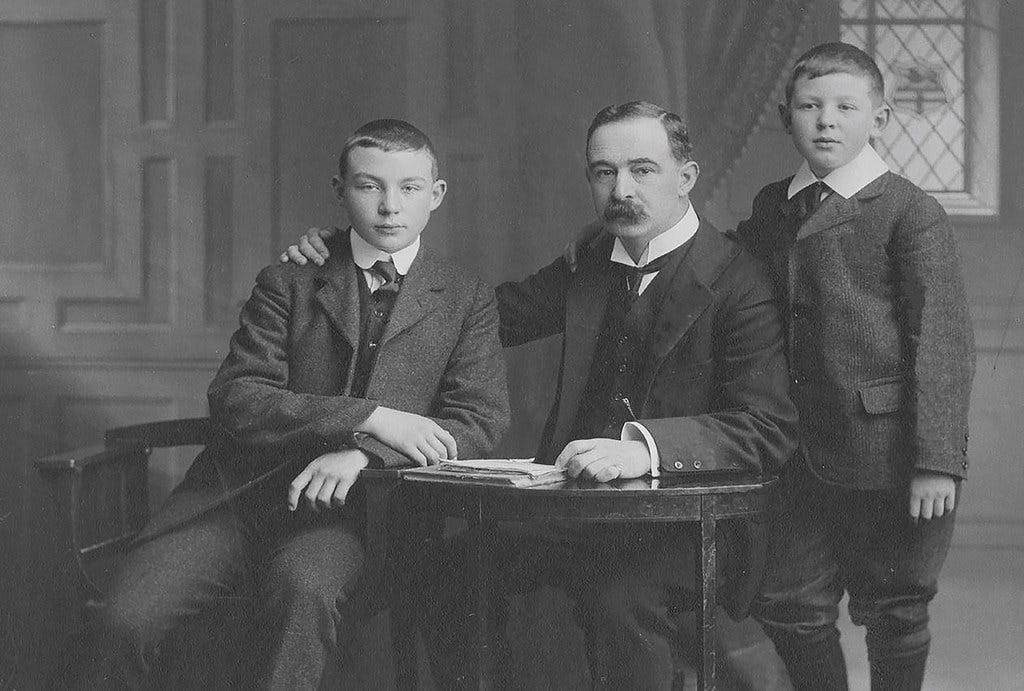
Jack Lewis, who had spent the morning “running wild” in shorts, was not happy about this transition to the life of a schoolboy. He wrote:
Nothing in my experience had ever suggested to me that it was nicer to be a schoolboy than a child or nicer to be a man than a schoolboy. My brother never talked much about school in the holidays. My father, whom I implicitly believed, represented adult life as one of incessant drudgery under the continual threat of financial ruin. In this he did not mean to deceive us. Such was his temperament that when he exclaimed, as he frequently did, “There’ll soon be nothing for it but the workhouse,” he momentarily believed, or at least felt, what he said. I took it all literally and had the gloomiest anticipation of adult life. In the meantime, the putting on of the school clothes was, I well knew, the assumption of a prison uniform.
Warnie gave Jack a grand tour of the ship, which cheered up the boy. They then retired to their bunks for the overnight crossing. The wind blew hard that night, tossing the ship about on the waves. Poor Warnie grew terribly seasick, which gave Jack a good deal of envy (who wanted to experience the proper seasickness of an experienced traveler), and who only succeeded, by great efforts, in vomiting once the entire night.
When the boys disembarked in the morning and boarded the train for London, Jack hated his first sight of England. The flats of Lancashire looked to him like the banks of the River Styx, the landscape from Fleetwood to Euston he found dull and unfriendly, the flatness of the land he found suffocating, and the English accents seemed to him the voices of demons.
As an adult, Lewis would reflect on his thoughts by quoting the Kalevala.
“In the stranger’s house the floor is full of knots.”
He had a hatred for England that took many years to heal.
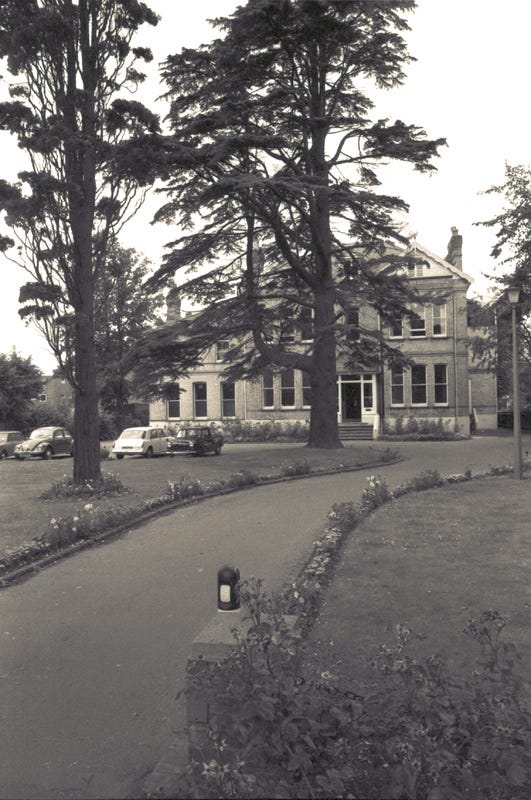
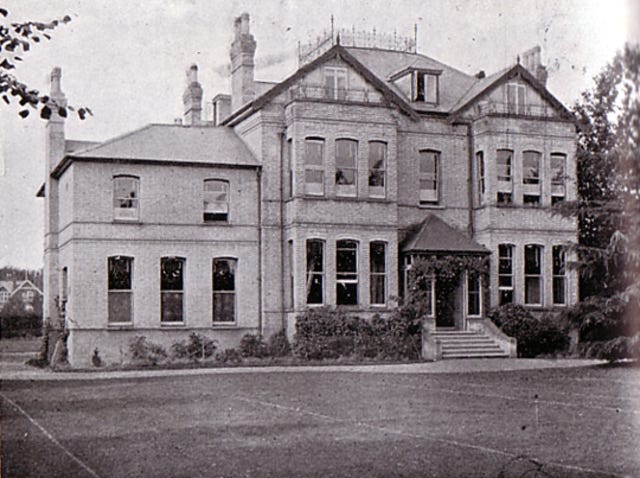
The boys, after switching trains at Euston, soon arrived at Jack’s very first school. Wynyard House, Watford, in Hertfordshire. (In his memoirs, he would refer to the place as Belsen, in reference to the Nazi concentration camp.) The school was unimpressive, consisting of a couple of yellow bricked buildings and less than twenty pupils, with about half of them staying at the school as boarders.

When Jack first arrived, he put on a brave face. Writing to his father Albert, “I cannot of course tell you yet but I think I shall like this place, Misis [sic] Capron and the Miss Caprons are very nice and I think I will be able to get on with Mr. Capron though to tell the truth he is rather eccentric.”
Reverend Robert Capron, the headmaster of Wynyard, known as “Oldie” to the boys, was a cruel, hot headed man, frequently caning the boys for the smallest of mistakes. Warnie would later write of him, “I have seen him lift a boy of twelve or so from the floor by the back of his collar, and holding him at arm’s length as one might a dog, proceed to refresh the unfortunate youth’s memory by applying his cane to his calves.”
Oldie had his favorite victims, usually boys of a lower class, who in his eyes could do nothing right. C.S. Lewis writes,
“I have known Oldie enter the schoolroom after breakfast, cast his eyes round, and remark, “Oh, there you are, Rees, you horrid boy. If I’m not too tired I shall give you a good drubbing this afternoon.” He was not angry, nor was he joking. He was a big, bearded man with full lips like an Assyrian king on a monument, immensely strong, physically dirty. Everyone talks of sadism nowadays but I question whether his cruelty had any erotic element in it. I half divined then, and seem to see clearly now, what all his whipping-boys had in common. They were the boys who fell below a certain social status, the boys with vulgar accents. Poor P.—dear, honest, hard-working, friendly, healthily pious P.—was flogged incessantly, I now think, for one offence only; he was the son of a dentist. I have seen Oldie make that child bend down at one end of the schoolroom and then take a run of the room’s length at each stroke; but P. was the trained sufferer of countless thrashings and no sound escaped him until, towards the end of the torture, there came a noise quite unlike a human utterance. That peculiar croaking or rattling cry, that, and the grey faces of all the other boys, and their deathlike stillness, are among the memories I could willingly dispense with.”
Though Oldie was cruel, the boys got very little learning done. They would hammer away at endless Latin exercises, without reading any actual Latin texts. Oldie did very little teaching outside of the subject of Geometry, which was a personal favorite of his. During a class, he would call the boys to the front, quizzing them with questions, if the boys did not answer to his satisfaction, he would call for his cane to flog them. He would spend class sessions pacing about the room, banging with his cane against the confused boys’ desks, shouting, “THINK-THINK-THINK!!”. When worked up in a froth of anger, Oldie would leap and dance around, babbling, “Aye, aye, aye, aye.” All of this while his son, called Wee Wee, or one of his daughters, would do little, whispered lessons with the pupils at their desks. Though, throughout most of their time spent in class, the boys would be made to take up their slate chalkboards, and work on endless arithmetic sums. Lessons in the arts and sciences were few and far between, islands in a sea of chaos and monotony.
Lewis wrote, describing these reprieves from endless math thusly:
“Which like to rich and various gems inlaid The unadorned bosom of the deep —the deep being a shoreless ocean of arithmetic.”
At the end of the morning, each boy had to announce how many sums he had done. Jack’s older brother Warnie, would daily announce that he had done five sums. This was the truth, however it was also true, though the fact was not mentioned to his headmaster, that they were the same five sums, repeated daily.
Jack, in his memoirs, wonders at just how many thousands of times his brother must have repeated these same math problems.
After about two weeks of this treatment, Jack was ready to come home, as can be seen in a letter written to his father.
‘My dear Papy, Mr. Capron said something I am not likely to forget – “Curse the boy” (behind Warnie’s back) because Warnie did not bring his jam to tea, no one ever heard such a rule before. Please may we not leave on Saturday? We simply CANNOT wait in this hole until the end of term … Your loving son Jack.’
Later in the term, Oldie’s wife died, making him even crueler, and more violent than before, which caused his son, Wee Wee, to apologize to the boys for his father’s erratic behavior. After the experience of the loss of his mother, and the chaos of his headmaster’s bereavement, Lewis came to hate the display of emotion, writing,
“You will remember that I had already learned to fear and hate emotion; here was a fresh reason to do so.”
Oldie’s violence was extreme enough that the parents of one of his pupils brought a High Court action against him, causing a scandal that brought the total number of students at Wynyard down to only nine, Jack among them.
Warnie wrote of Jack’s time there,
“As he has made very clear, he hated the place, but he escaped its worse brutalities: he amused the headmaster, who even made something of a pet of him, so far as was possible for such a man.”
Lewis, later looking back on his experiences at Wynyard, restrains himself from devoting too much of his memoir to Oldie’s cruelties. He even explains a positive aspect of his character when relating the story of a boy who confessed to Oldie a lie that would have otherwise have been undetectable. “The ogre was touched; he only patted the terrified boy’s back and said, “Always stick to the truth.” He also explains that Oldie, though cruel in his methods, taught geometry and the reasoning behind it quite well. He also relates that, years later, he met a man who had grown up near Oldie’s school, who believed Oldie to be insane. This insanity may explain the state of the school in Lewis’s time, which in the past, had boasted many successful scholars as graduates.
Albert Lewis could not be blamed for his choice of school, as he did his research. He and Flora, when initially choosing the school for Warnie, sought the advice of an agency called Gabbitas and Thring, an educational agency that found teachers for schools and students to attend them, which had highly recommended Wynyard. Wynyard also had a successful pedigree of graduates. It seemed a proper choice. Once the boys were both pupils, Warnie sent a letter, asking to go instead to Campbell college close to home, writing, “Jack and I have been thinking it over, and we both think we would like to go to Campbell College. Of course, as you say the boys may not be gentlemen, but no big school is entirely composed of gentlemen, and I think English boys are not so honest or gentlemanly as most Irish ones.”

Albert, for his part, wrote to Oldie requesting to have his sons withdrawn from Wynyard, but he accepted Oldie’s word that all was well. He was also in a state of bereavement that didn’t allow him the time to properly reflect upon the concerns and cares of his Jack and Warnie.
The boys also, outside of the aforementioned letters, didn’t make much of an effort to tell their father about their sufferings at Wynyard. Their letters were never dire enough for Albert to truly understand their suffering. For one, the boys had no other school to compare their experience at Oldie’s to. It was the only one they had ever attended, so they figured the same miseries would be found at all schools. They believed their lot to be a common one. Also, they had a certain vanity and pride to preserve during their short visits home. As Lewis writes,
A boy home from school (especially during that first week when the holidays seem eternal) likes to cut a dash. He would rather represent his master as a buffoon than an ogre. He would hate to be thought a coward and a cry-baby, and he cannot paint the true picture of his concentration camp without admitting himself to have been for the last thirteen weeks a pale, quivering, tear-stained, obsequious slave. We all like showing scars received in battle; the wounds of the ergastulum, less. My father must not bear the blame for our wasted and miserable years at Oldie’s; and now, in Dante’s words, “to treat of the good that I found there”
Lewis, reflecting in his later years, believes that Oldie’s indeed did him some good. He learned to make friends, or at the very least, to be sociable. This was all the more necessary, when, in 1909, Warnie matriculated to Malvern college (at the suggestion of Oldie no less), leaving Jack behind. The boys of Wynyard, in their suffering, became a band of brothers in many ways. Instead of bullying one another and quarreling, they grew closer. In their freetime, they would wander into the village, buying sweets at the shops, playing on the banks of the canal, and watching the railroad tunnel for trains. They would even get into minor philosophical debates, like one on the nature of the future, whether it was like a line you can’t see or like a line that is not yet drawn. The boys, felt like allies, united as “we happy few” against a larger enemy in their cruel headmaster. Lewis held a lifelong love of friendship, writing:
Hence while friendship has been by far the chief source of my happiness, acquaintance or general society has always meant little to me, and I cannot quite understand why a man should wish to know more people than he can make real friends of.
Lewis, in his lifetime, would come to develop intimate friendships that would have a tremendous impact upon his work. His friendships, in many ways, would come to define him.
Lewis also believed that Oldie’s school was good for his religious formation. They were taken to, St John’s, Watford, an Anglo-Catholic church twice every Sunday, where he would hear the doctrines of Christianity from men who held a firm belief in them. He began, for the first time, to seriously consider the fate of his soul. Leading him to spend more time in prayer, studying his Bible, discussing religion with his school mates, and doing his best to obey his conscience. Lewis wrote of this time:
“There first I became an effective believer. As far as I know, the instrument was the church to which we were taken twice every Sunday. This was high “Anglo-Catholic”. On the conscious level I reacted strongly against its peculiarities—was I not an Ulster Protestant, and were not these unfamiliar rituals an essential part of the hated English atmosphere? Unconsciously, I suspect, the candles and incense, the vestments and the hymns sung on our knees, may have had a considerable, and opposite, effect on me. But I do not think they were the important thing. What really mattered was that I here heard the doctrines of Christianity (as distinct from general “uplift”) taught by men who obviously believed them. As I had no scepticism, the effect was to bring to life what I would already have said that I believed. In this experience there was a great deal of fear. I do not think there was more than was wholesome or even necessary; but if in my books I have spoken too much of Hell, and if critics want a historical explanation of the fact, they must seek it not in the supposed Puritanism of my Ulster childhood but in the Anglo Catholicism of the church at Belsen. I feared for my soul; especially on certain blazing moonlit nights in that curtainless dormitory—how the sound of other boys breathing in their sleep comes back! The effect, so far as I can judge, was entirely good.”
Though he writes positively of his experiences in an Anglo-Catholic church when looking back in his memoirs, it is worth noting that he felt much less charitable at the time, writing in his journal. “In this abominable place of Romish hypocrites and English liars, the people cross themselves, bow to the Lord’s table (which they have the vanity to call an altar) and pray to the Virgin.”

While his intellectual life at Oldie’s was mediocre at best, outside of geometry and an endless sea of arithmetic at least, he got a good deal of reading in, though he felt his imaginative life had substantially declined. He enjoyed reading school-stories in The Captain, pure wish fulfillment fantasy of the underdog becoming captain of the rugby team. He also devoured historical fiction set in the ancient world such as Quo Vadis, Darkness and Dawn, The Gladiators, and Ben Hur. Though these stories had Christian elements, he desired the more carnal aspects of the ancient world, “sandals, temples, togas, slaves, emperors, galleys, (and) amphitheatres”. The adventure stories of Rider Haggard caught his imagination, as well as a ravenous hunger for science fiction stories, such as those of H.G. Wells. Lewis, reflecting upon it, thought there may be a psychoanalytical explanation for his course love of scifi. In fact, he claims to have written his own science fiction stories in an effort to exorcise his overwhelming desire for planetary romances, reconciling his desire to the imaginative impulse of storytelling, thus, taming it.
Finally, Lewis’s time at Wyndham trained him for the hardships of the Christian life. As he writes in Surprised by Joy:
“Life at a vile boarding-school is in this way a good preparation for the Christian life, that it teaches one to five by hope. Even, in a sense, by faith; for at the beginning of each term, home and the holidays are so far off that it is as hard to realise them as to realise heaven. They have the same pitiful unreality when confronted with immediate horrors. To-morrow’s geometry blots out the distant end of term as to-morrow’s operation may blot out the hope of Paradise. And yet, term after term, the unbelievable happened. Fantastical and astronomical figures like “This time six weeks” shrank into practicable figures like “This time next week”, and then “This time to morrow”, and the almost supernatural bliss of the Last Day punctually appeared. It was a delight that almost demanded to be stayed with flagons and comforted with apples; a delight that tingled down the spine and troubled the belly and at moments went near to stopping the breath. Of course this had a terrible and equally relevant reverse side. In the first week of the holidays we might acknowledge that term would come again—as a young man, in peace time, in full health, acknowledges that he will one day die. But like him we could not even by the grimmest memento mori be brought to realise it. And there too, each time, the unbelievable happened. The grinning skull finally peered through all disguises; the last hour, held at bay by every device our will and imaginations knew, came in the end, and once more it was the bowler-hat, the Eton collar, the knickerbockers, and (clop-clop-clop-clop) the evening drive to the quay. In all seriousness I think that the life of faith is easier to me because of these memories. To think, in sunny and confident times, that I shall die and rot, or to think that one day all this universe will slip away and become memory (as Oldie slipped away into memory three times a year, and with him the canes and the disgusting food, the stinking sanitation and the cold beds)—this is easier to us if we have seen just that sort of thing happening before. We have learned not to take present things at their face value.”
During the time spent at Wynyard, Jack and Warnie began to grow more and more distant from their father. During their school breaks, he would be away at work from nine to six, and though he could be a jovial companion, the boys weren’t of a proper age to appreciate it. They simply did not have enough experience of life to understand his humor. Their father Albert, was also in grief, causing him to more easily lose his temper. When he would grow angry at the boys, such as at a time when they cut up a stepladder with a hatchet to build a tent in the garden, he would use all of his skills of oratory to lecture the boys. At first, the harangues terrified a young Lewis and were an effective punishment. He even came to believe, due to his father’s rants, that their ruin was imminent, and that as Lewis writes, “he would shut up the house and keep us at school all the year round, that we should be sent to the colonies and there end in misery the career of crime on which we had, it seemed, already embarked. All security seemed to be taken from me; there was no solid ground beneath my feet. It is significant that at this time if I woke in the night and did not immediately hear my brother’s breathing from the neighbouring bed, I often suspected that my father and he had secretly risen while I slept and gone off to America—that I was finally abandoned. Such was the effect of my father’s rhetoric up to a certain age; then, quite suddenly, it became ridiculous.”
At a certain point, Jack, instead of seeing his father in these lectures, saw a buffoonish caricature of Cicero or Burke. His speeches would be full of similes, rhetorical questions, and wild gestures. His father would also use many dramatic pauses when speaking to the boys. As Lewis relates one incident,
“One was so long that my brother, quite innocently supposing the denunciation to have ended, humbly took up his book and resumed his reading; a gesture which my father (who had after all only made a rhetorical miscalculation of about a second and a half) not unnaturally took for “cool, premeditated insolence”. The ludicrous disproportion between such harangues and their occasions puts me in mind of the advocate in Martial who thunders about all the villains of Roman history while meantime lis est de tribus capellis— This case, I beg the court to note, Concerns a trespass by a goat.”
Jack, with the horrors of his school life, the alienation from his father, and the loss of his mother was having a rough go of things. Though things would begin to improve. In the summer of 1910, Oldie’s school would close its doors for good. As Warnie records it,
“In 1910 the headmaster wrote to my father that he was ‘giving up school work’, which meant deliverance for Jack: in fact the school collapsed, the house was sold, and its proprietor retired to a country living. There, his behaviour towards his choir and churchwardens was such that he was put under restraint and certified insane: he died in 1912, soon afterwards. With his uncanny flair for making the wrong decision, my father had given us helpless children into the hands of a madman “
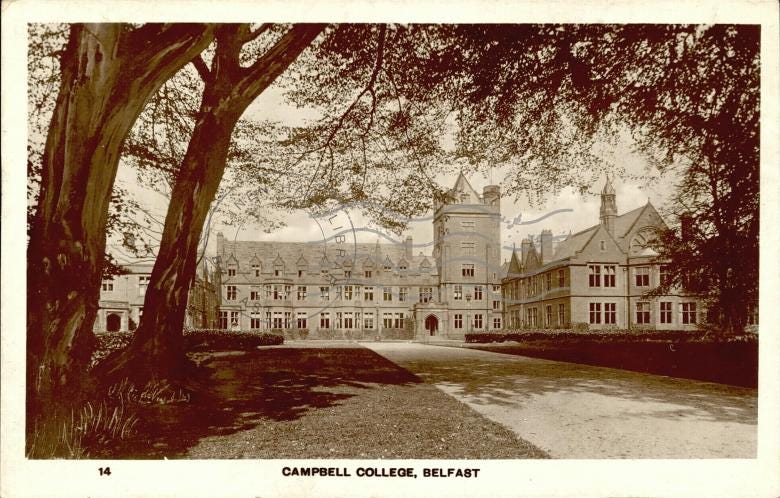
With the closure of Oldie’s, Jack would head to an educational institution just a mile from home. Campbell college.
I’m Barbarian Herodotus, follow for more masculine virtue.