
Theodore Roosevelt wrote about reading.
“I am old- fashioned, or sentimental, or something about books! Whenever I read one, I want, in the first place, to enjoy myself, and in the next place, to feel that I am a little better and not a little worse for having read it.”
He was a voracious reader, who read whenever he could, wherever he could, whether it was on the campaign trail, while exploring the Amazon, or even when chasing boat thieves across the badlands of the Dakotas. As Roosevelt put it:
“I have always taken books with me when on hunting and exploring trips. In such cases the literature should be reasonably heavy, in order that it may last”
Just look at this daily schedule of his from a day spent campaigning.
7:00 AM Breakfast
7:30 AM A speech
8:00 AM Reading a historical work
9:00 AM A speech
10:00 AM Dictating letters
11:00 AM Discussing Montana mines
11:30 AM A speech
Noon Reading an ornithological work
12:30 PM A speech
1:00 PM Lunch
1:30 PM A speech
2:30 PM Reading Sir Walter Scott
3:00 PM Answering telegrams
3:45 PM A speech
4:00 PM Meeting the press
4:30 PM Reading
5:00 PM A speech
6:00 PM Reading
7:00 PM Supper
8-10 PM Speaking
11:00 PM Reading alone in his car
Midnight To bed.
According to Edmund Morris, the author of a tremendous trilogy on the life of TR, “Roosevelt consumed, and largely memorized, between three and five hundred books a year.”
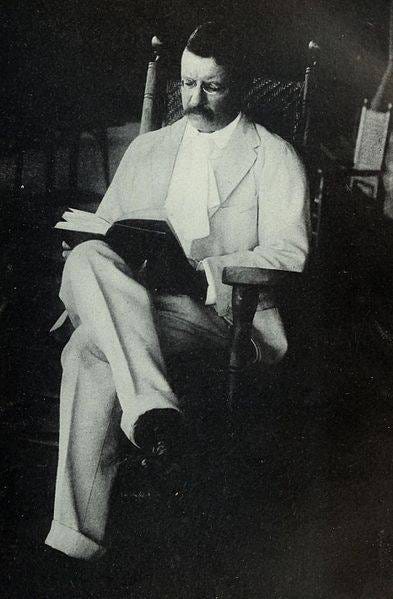
A friend of Roosevelt’s, author Owen Wister, recalled a time when TR read an entire work over the course of a single night: “Somewhere between six one evening and eight-thirty next morning, beside his dressing and his dinner and his guests and his sleep, he had read a volume of three-hundred-and-odd pages, and missed nothing of significance that it contained.”
Roosevelt would often read in the evenings, but would fit it into every spare moment as he explained:
“I almost always read a good deal in the evening; and if the rest of the evening is occupied I can at least get half an hour before going to bed. But all kinds of odd moments turn up during even a busy day, in which it is possible to enjoy a book; and then there are rainy afternoons in the country in autumn, and stormy days in winter, when one’s work outdoors is finished and after wet clothes have been changed for dry, the rocking chair in front of the open wood fire simply demands an accompanying book.”
When he passed away on January 6, 1919, there were close to 12,000 volumes in his library at Sagamore Hill. He filled every room of the house with books.
Roosevelt wrote about the books in his Sagamore Hill home,
“At Sagamore Hill we love a great many things—birds and trees and books, and all things beautiful, and horses and rifles and children and hard work and the joy of life.
The books are everywhere. There are as many in the north room and in the parlor—is drawing-room a more appropriate name than parlor?—as in the library; the gun-room at the top of the house, which incidentally has the loveliest view of all, contains more books than any of the other rooms; and they are particularly delightful books to browse among, just because they have not much relevance to one another, this being one of the reasons why they are relegated to their present abode. But the books have overflowed into all the other rooms too.”
![Theodore Roosevelt's library in Sagamore Hill [900 x 569] : r/bookporn](https://substackcdn.com/image/fetch/$s_!yuzG!,f_auto,q_auto:good,fl_progressive:steep/https%3A%2F%2Fsubstack-post-media.s3.amazonaws.com%2Fpublic%2Fimages%2F390bde52-dc61-4cf5-b5f3-826b876a52df_900x569.jpeg "Theodore Roosevelt's library in Sagamore Hill [900 x 569] : r/bookporn")
TR was a lover of books. But what books shaped him? What books did he enjoy? What books did he read to his children? An all-inclusive list is impossible, but I am going to give you a picture of the reading life of Theodore Roosevelt.
In boyhood, Teddy Roosevelt was small, sickly, and weak. Being asthmatic, near-sighted, and home-schooled, Roosevelt spent lots of time cooped up indoors with his books. When he was 8 years old, his father gave him a copy of Homes Without Hands: Being A Description Of The Habitations Of Animals, Classed According To Their Principle Of Construction (1865) by John George Wood.
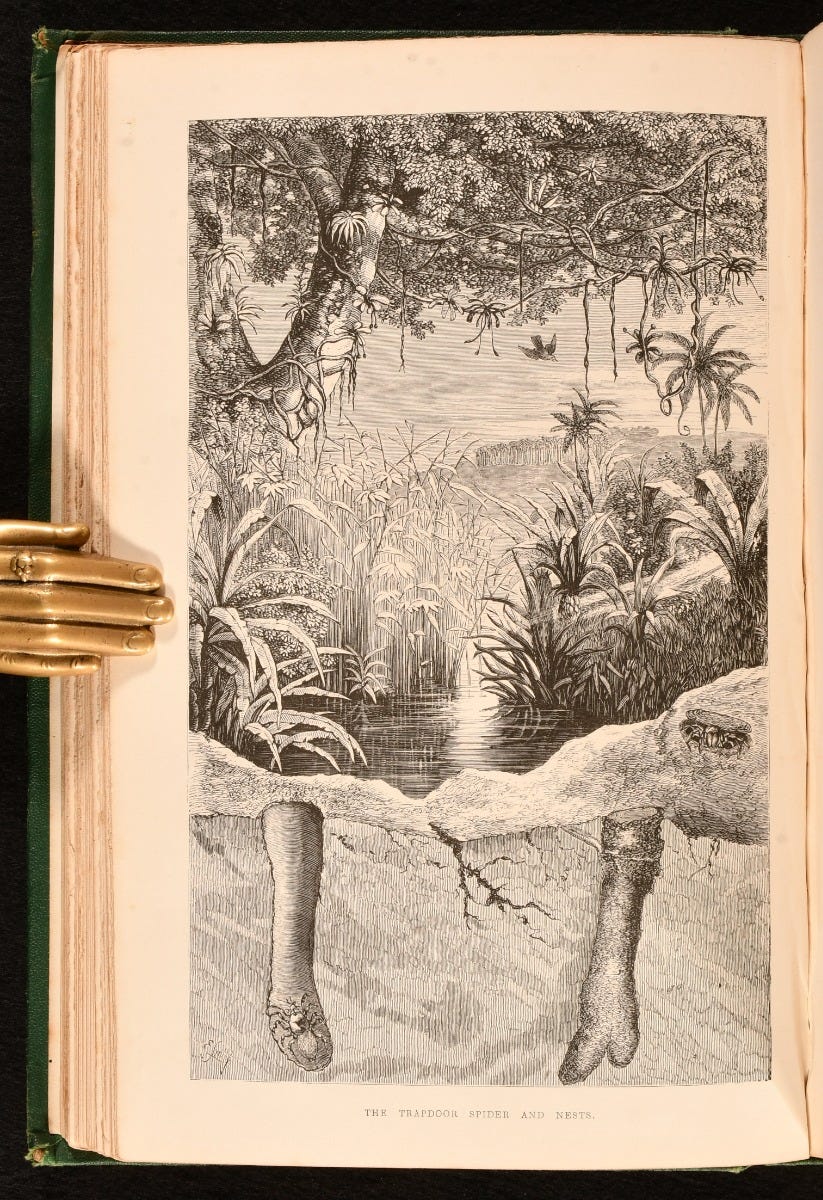
Although it was a university level zoology textbook, young Roosevelt loved its many engravings and illustrations. He especially loved Wood’s descriptions of animal nests, tunnels, and burrows. Reading this work led the 8 year old boy to even attempt to mimic its author, writing an essay called “The Foraging Ant,” about the work ethic of ants. An essay which he proudly read to his parents.
Homes without Hands, helped spark a love of the natural world in a young Roosevelt, and even encouraged him to dream of a career in the natural sciences.
Another book that Roosevelt loved as a youth was John James Audubon’s The Birds of America. While on a family trip to Europe in 1872, a 14 year old Roosevelt borrowed a copy from his Aunt in Liverpool, spending hours poring over every page. He eventually got a copy of his own, becoming a devoted ornithologist, and even studying taxidermy. He brought his copy of The Birds of America with him to Harvard where he hoped to study the natural sciences and to do fieldwork in the vein of Audubon. After his first summer at Harvard, he and a friend spent the summer studying the birds of his home state of New York, writing a small booklet titled, “The Summer Birds of The Adirondacks.”
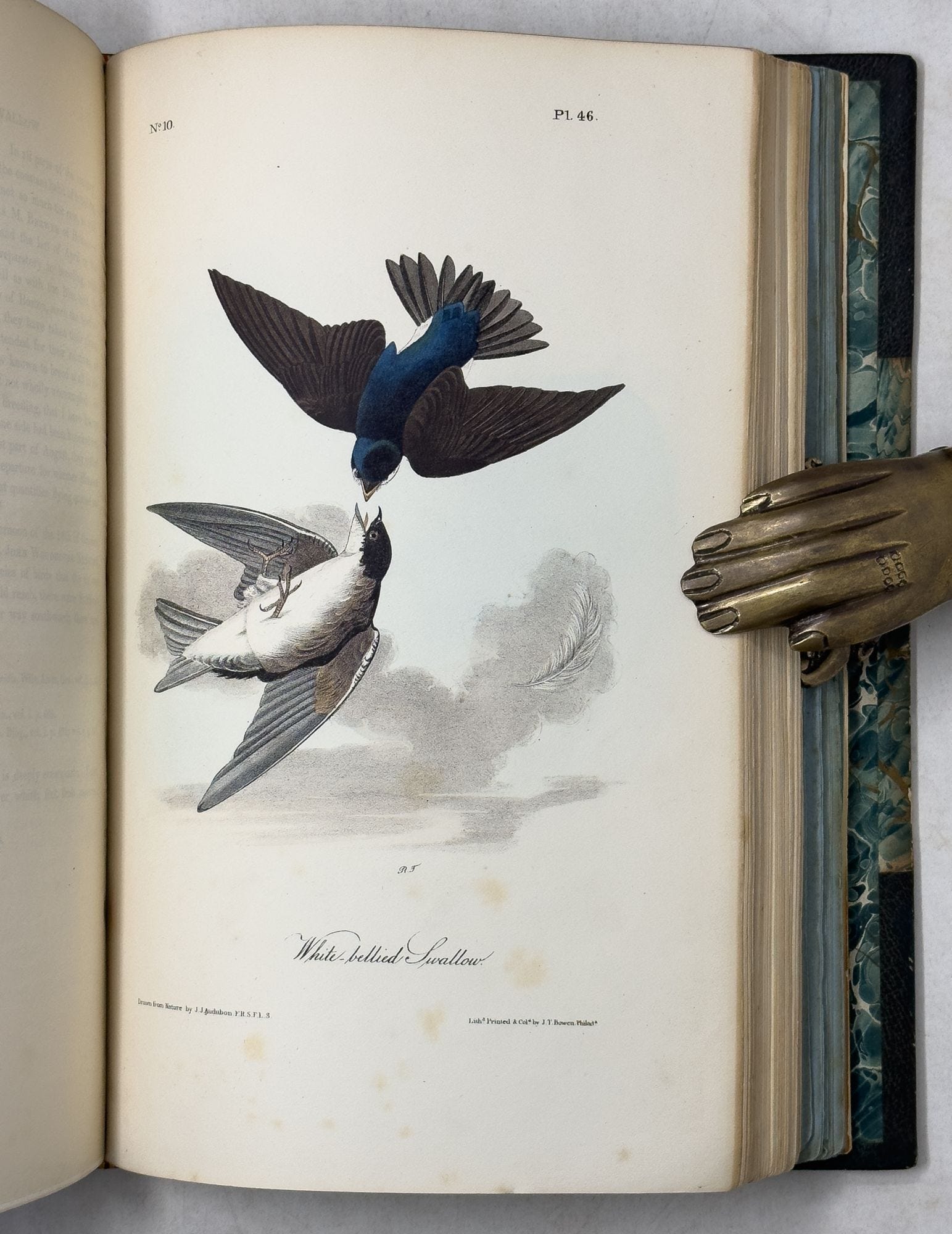
Later, Roosevelt would help George Bird Grinnell found the Audubon Society in 1886 and would support his efforts to protect endangered birds. During his presidency, Roosevelt would sign an executive order, establishing Pelican Island off of the coast of Florida as the first federal bird reservation, going on to establish multiple bird preserves during his time in office.
Roosevelt would have a lifelong love of ornithology.
A prodigious reader of novels in his boyhood, Roosevelt developed a great love for the book, The Boy Hunters by Thomas Mayne Reid. The Boy Hunters follows three brothers who set off across the American Prairie in pursuit of a rare white buffalo. Along their journey, they encounter the flora and fauna of the Americas, including alligators, bears, deer, buffalo, and other creatures which they hunt and get into scrapes with. They even encounter the tribes of the plains. This naturalist adventure story set in the American West would encourage Roosevelt’s own enchantment with the west throughout his life. Roosevelt wrote that the book “strengthened my instinctive interest in natural history. I was too young to understand much of Mayne Reid, excepting the adventure part and the natural history part-these enthralled me.”
Another adventure story that brought a young Roosevelt joy was Mr. Midshipman Easy by Frederick Marryat. Set during the Napoleonic Wars, the novel describes life, combat, and adventure in the Royal Navy. Mr. Midshipman Easy would encourage a lifelong interest in and love of Naval History in Roosevelt. The adventurous story also appealed to a scared, sickly little boy, who desperately desired to be strong and courageous.
In his book, Becoming Teddy Roosevelt, author Andrew Vietze expounds upon the effect the novel had on young TR.
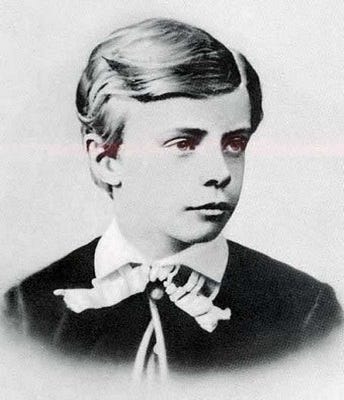
“He didn’t want to be confined to the sickroom, he didn’t want to be afraid of the bigger boys, and he didn’t want to be so shy. In later years he often referred to an incident in Frederick Marryat’s Mr. Midshipman Easy where a sea captain on a British man-of-war is counseling a sailor who is struggling with his fears.
The captain tells him that he, too, used to be afraid heading into action, but made up his mind to act unafraid. Despite how he felt inside he would give the outward appearance of courage—and after a while that was how he actually felt. It was a lesson that stuck in TR’s mind-whatever circumstances he confronted he was determined to act courageous.”
His favorite poet during his childhood was Henry Wadsworth Longfellow. As he wrote in his autobiography, “Even in poetry it was the relation of adventures that most appealed to me as a boy. At a pretty early age I began to read certain books of poetry, notably Longfellow’s poem, “The Saga of King Olaf, which absorbed me.”
Young Theodore also greatly enjoyed the children’s Magazine, Our Young Folks, looking forward to every issue. Later writing, “As a small boy I had Our Young Folks, which I then firmly believed to be the very best magazine in the world—a belief, I may add, which I have kept to this day unchanged, for I seriously doubt if any magazine for old or young has ever surpassed it.”
At Harvard, Roosevelt’s love of Naval history deepened. He read as many books as he could on the subject, with one being particularly impactful. James Fenimore Cooper’s Naval History of The United States. Cooper, the author of The Last of The Mohicans, which Roosevelt loved as a boy, served in the Navy, and wrote a literary form of Naval history based on his own experiences. Roosevelt greatly enjoyed Cooper’s history of the U.S. Navy but felt it was lacking in regard to the British point of view during the War of 1812. In response, Roosevelt set out to write an unbiased account of the naval battles of the War of 1812, publishing his first major work, The Naval War of 1812 in 1882 at the age of only 23.
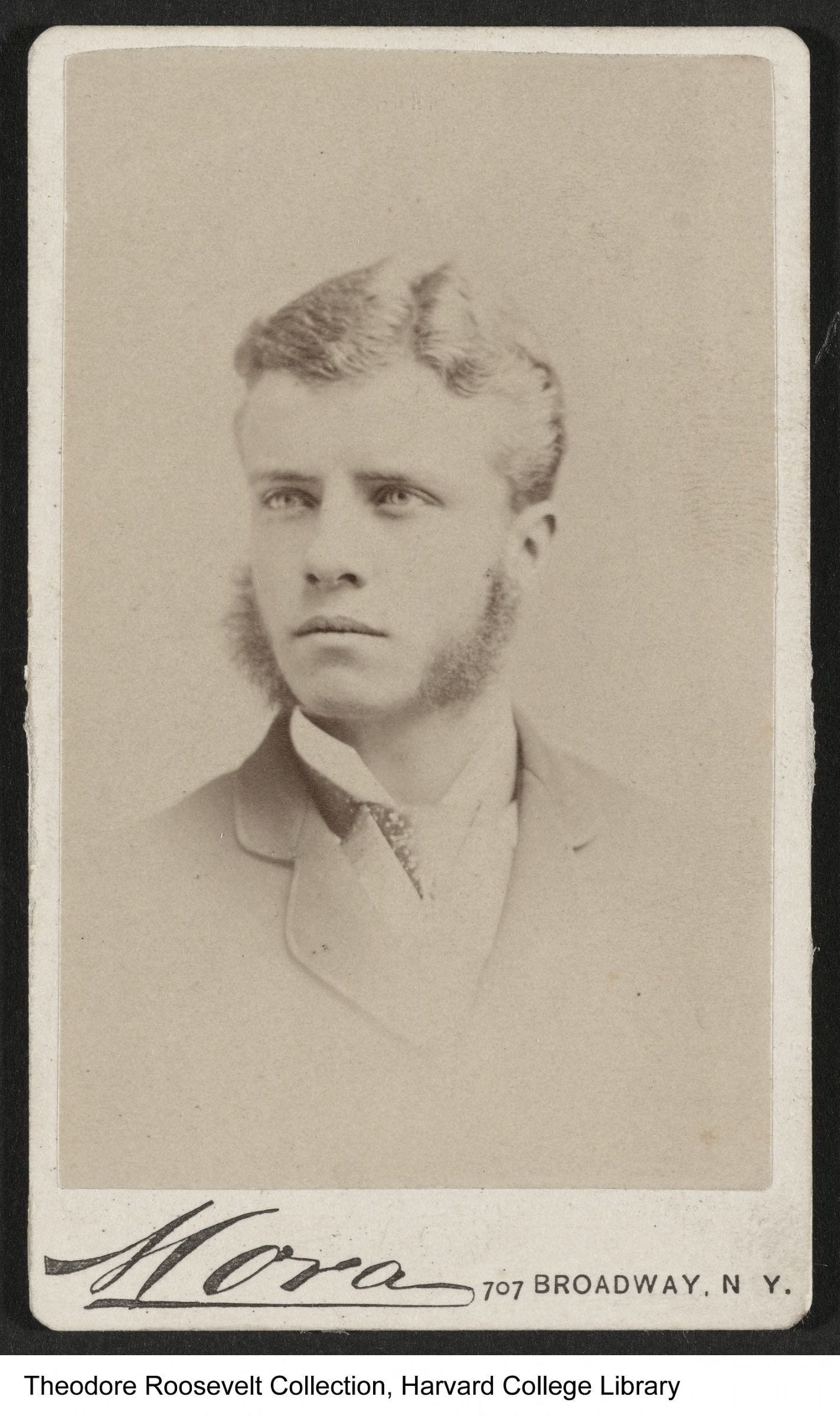
Roosevelt’s work was a great achievement, with the U.S. Navy ordering for a copy to be placed on every ship. Roosevelt’s book would go on to influence another author of naval history, Alfred Thayer Mahan, who wrote a book that would, in turn, greatly influence Roosevelt. The Influence of Sea Power Upon History.
After reading Mahan’s naval history in the spring of 1890, Roosevelt immediately sent him a letter praising the book, beginning a regular correspondence. Due to the influence of Mahan’s work, Roosevelt became a tireless advocate for the modernization and strengthening of America’s Navy. Because of this, he was named Assistant Secretary of the Navy in 1897. During his time in office, Roosevelt would continue to seek Mahan’s advice, and would encourage Naval officers to read and internalize the teachings of Mahan’s work. Roosevelt fully bought into the idea that national greatness is tied to a strong Navy. To showcase this, as president, Roosevelt sent the Great White Fleet, a group of 14 American battleships painted a brilliant white, on a 14-month tour circumnavigating the globe, showing that the United States could project its naval power across the seas of the world.
Another work of history that had an influence on Roosevelt was Francis Parkman’s The Oregon Trail: Sketches of Prairie and Rocky-Mountain Life. Parkman, a fellow Harvard Alumnus, journeyed through Nebraska, Wyoming, Colorado, and Kansas during the summer of 1846, when he was 23 years old, and published an account of his adventures 3 years later in 1849. Roosevelt, after losing his wife and mother on Valentine’s Day, 1884, fled out west in his grief, to the Dakotas, to try his hand at ranching in the land which had enchanted him since boyhood. It was there at his Elkhorn ranch where he read Parkman’s The Oregon Trail, and was electrified by the classical and historical prose used to honor the western frontier. Roosevelt, eternally a lover of the great American west, its rugged landscapes, and bountiful wildlife which he enjoyed to hunt, wrote his own history of the west which he dedicated to Parkman. A four volume history titled, The Winning of the West.
While at Elkhorn ranch, Roosevelt also enjoyed reading great works of fiction.
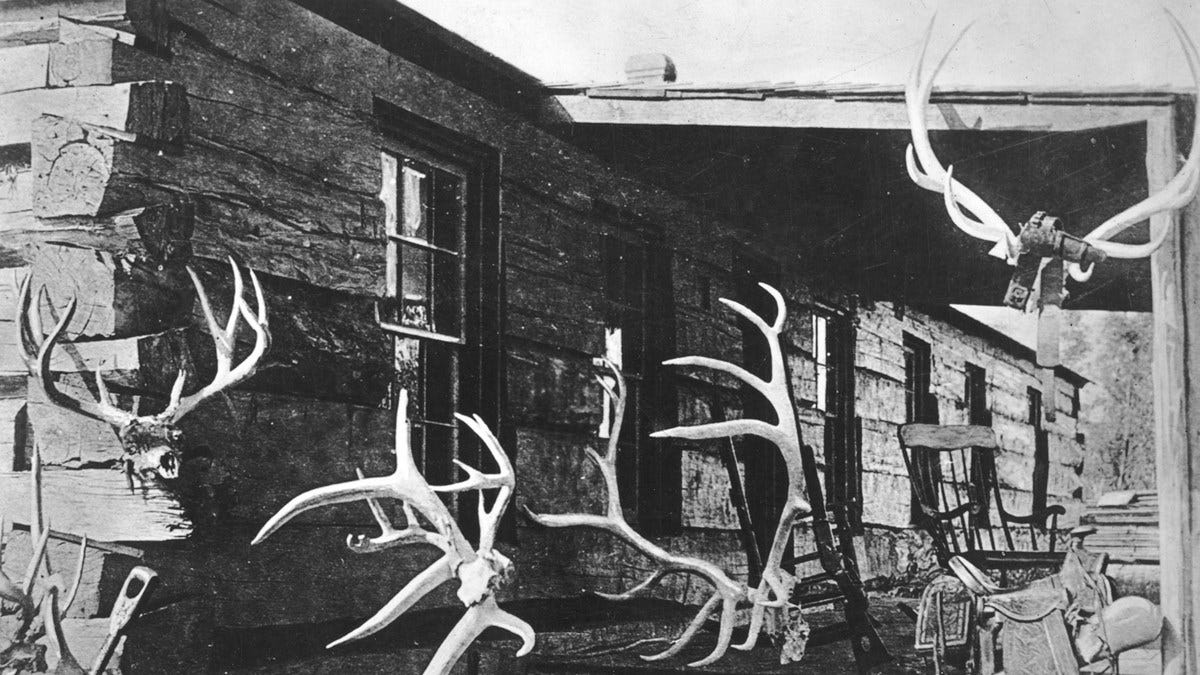
According to his biographer Edmund Morris, Elkhorn’s “Sturdy shelves groaned with the collected works of Irving, Hawthorne, Cooper, and Lowell.”
Once, in 1886, in the early spring, three thieves cut TR’s boat from its mooring on the Little Missouri River near his ranch. Roosevelt was a deputy sheriff at the time, and along with his ranch hands, chased down and arrested the thieves, traveling over 300 miles, and marching the prisoners to the town of Dickinson to the sheriff at gunpoint. During his time traveling down the icy river in pursuit, Roosevelt read Anna Karenina, Leo Tolstoy’s classic novel of love, betrayal, faith, and desire in Imperial Russia. Roosevelt recognized that the novel, paired well with the bleak winter wilderness of the Dakotas, writing “I had brought with me ‘Anna Karénina,’ and my surroundings were quite grey enough to harmonize well with Tolstoy.”
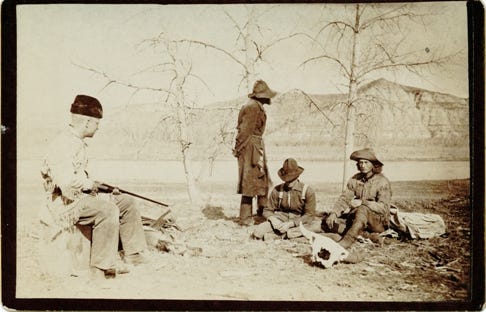
While in the Dakotas, Roosevelt also read Henry Cabot Lodge’s biography of Daniel Webster, the constitutional lawyer, U.S. senator, and secretary of state. Lodge wrote it as part of the American Statesmen Series published by Houghton, Mifflin, and Company. Roosevelt, inspired by the biography, wrote to his good friend Henry Cabot Lodge in hopes of writing a biography of his own for the American Statesmen Series. Roosevelt then received a commission to write a biography of Thomas Hart Benton, the U.S. senator and western expansionist, which he wrote in the solitude of his ranch. This biography was the first of many for Roosevelt, including one on founding father Gouverneur Morris, and a series of biographies of American heroes for children titled, Hero Tales from American History.
Roosevelt, throughout his life, would find inspiration from the lives of others and from history. Reading works from Thucydides, Herodotus, and finding inspiration from Plutarch’s lives. Of the value of reading History, Roosevelt says:
“History which is not professedly utilitarian, history which is didactic only as great poetry is unconsciously didactic, may yet possess that highest form of usefulness, the power to thrill the souls of men with stories of strength and craft and daring, and to lift them out of their common selves to the heights of high endeavor.”
He also found the reading of history to be a great stress reliever, writing,
“If one is worried by all kinds of men and events-during critical periods in administrative office, or at national conventions, or during congressional investigations or in hard-fought political campaigns—it is the greatest relief and unalloyed delight to take up some really good, some really enthralling book-Tacitus, Thucydides, Herodotus, Polybius, or Goethe, Keats, Gray or Lowell-and lose all memory of everything grimy, and of the baseness that must be parried or conquered.”
In 1890, Jacob Riis published How the Other Half Lives: Studies among the Tenements of New York. In it, Riis documents the squalid living conditions in the slums of New York City. Roosevelt read it soon after it was published, and was deeply impacted by it, calling on Riis soon after. Riis records,
“He came to my office one day when I was out and left his card with the simple words written upon it: “I have read your book, and I have come to help.” That was the beginning. The book was How the Other Half Lives, in which I tried to draw an indictment of the things that were wrong, pitifully and dreadfully wrong, with the tenement homes of our wage-workers. It was like a man coming to enlist for a war because he believed in the cause, and truly he did.”
When he became police commissioner of New York, Roosevelt made the effort to improve the living conditions in New York City’s tenements. He would bring Riis along with him when he would make his site investigations, writing, “I used to visit the different tenement-house regions, usually with Riis, to see for myself what the conditions were…. The trips that Riis and I took enabled me to see what the Police department was doing, and also gave me personal insight into some of the problems of city life.” Together, they would abolish police lodging houses, which housed the homeless and destitute, but were prone to outbreaks of typhus. They would also establish a Tenement House Commission and would push to decrease the working hours of women and children, among other reforms.
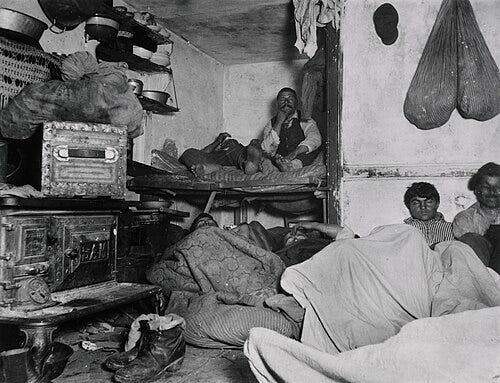
Roosevelt wrote of his relationship with Riis, “The man who was closest to me throughout my two years in the Police Department was Jacob Riis…. I already knew Jake Riis, because his book How the Other Half Lives had been to me both an enlightenment and an inspiration for which I could never be too grateful. Soon after it was written I had called at his office to tell him how deeply impressed I was by the book, and that I wished to help him in any practical way to try to make things a little better…. Jacob Riis had drawn an indictment of the things that were wrong… with the tenement homes. In his book he had pointed out how the city government, especially those connected with the departments of police and health, could aid in remedying some of the wrongs”
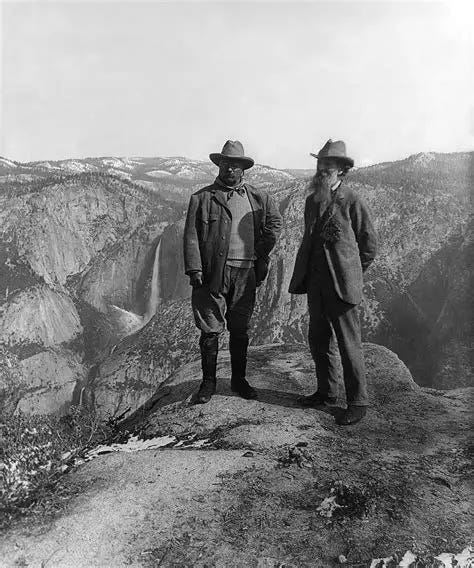
Theodore Roosevelt was a lifelong lover of America’s wilderness areas and was concerned about the threats to their continued existence. In 1901, he read John Muir’s Our National Parks, which was a collection of essays describing the national parks that existed at the time, Yosemite being one of them. Inspired by Muir’s writings, Roosevelt wrote to him seeking advice as to expanding the national park system, which led to them camping together for three nights at Yosemite.
Roosevelt wrote to Muir,
“I do not want anyone with me but you, and I want to drop politics absolutely for four days and just be out in the open with you!
Throughout their days camping, hiking, and bonding over their shared love of the wilderness, he and Roosevelt hatched a plan that led to the creation of five new national parks, and a tremendous expansion of national forest land. Upon Muir’s death in 1914, Roosevelt wrote an essay celebrating his friend’s life, saying of him, “Our generation owes much to John Muir.”
The writings of Gifford Pinchot, who is considered America’s first trained forester, also had an influence on Roosevelt. He and Roosevelt were friends, with Roosevelt consulting him on conservation issues, and even naming him chief of the U.S. Forest service in 1905.
Pinchot’s 1910 work, The Fight for Conservation, a manifesto on conservation, was particularly influential on Roosevelt. It opened with the following statement:
“The most prosperous nation of to-day is the United States. Our unexampled wealth and well-being are directly due to the superb natural resources of our country, and to the use which has been made of them by our citizens, both in the present and in the past. We are prosperous because our forefathers bequeathed to us a land of marvelous resources still unexhausted. Shall we conserve those resources, and in our turn transmit them, still unexhausted, to our descendants? Unless we do, those who come after us will have to pay the price of misery, degradation, and failure for the progress and prosperity of our day. When the natural resources of any nation become exhausted, disaster and decay in every department of national life follow as a matter of course. There-fore, the conservation of natural resources is the basis, and the only permanent basis, of national success. There are other conditions, but this one lies at the foundation.”
Roosevelt wrote a public letter promoting the book and its message, making conservation a cornerstone of his third campaign for the presidency. Roosevelt wrote of Pinchot, “Gifford Pinchot is the man to whom the nation owes most for what has been accomplished as regards the preservation of the natural resources of our country.”
In 1901, Roosevelt was provided an advance copy of Booker T. Washington’s Up From Slavery. After reading it, he wrote to Washington, thanking him for the book, writing, “Mrs. Roosevelt is as much pleased as I am with your book. I shall not try to tell you what I think about it, my dear sir, for I do not want to seem to flatter you too much….I do not know who could take your place in the work you are doing.”
Roosevelt was particularly impressed with Washington’s Tuskegee Institute, inviting him to dinner at the White House on October 16, 1901. Making Washington the first black person ever invited to do so.
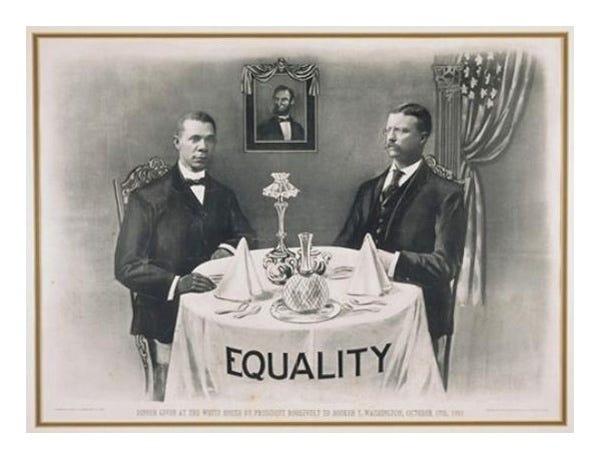
The dinner was a controversial one, but Roosevelt did not back down, writing,
“There are certain points where 1 would not swerve from my views if the entire people was a unit against me, and this is one of them. I would not lose my self-respect by fearing to have a man like Booker T. Washington to dinner if it cost me every political friend.”
Roosevelt would visit the Tuskegee Institute in 1905, where in a speech he stated,
“I will do all I can to help Tuskegee.”
Roosevelt was also a great lover of fiction in his later years, particularly his friend Owen Wister’s novel The Virginian, A Horsemen of the Plains, a western following a cowboy on a cattle ranch in the Wyoming territory, which Wister dedicated to Roosevelt. Roosevelt sent Wister a letter calling The Virginian “a remarkable novel.” Wister and his wife were even invited by Roosevelt to stay at the White House from January 8 to January 12, 1903.
In commenting on one of the dinners he had at the White House, Wister wrote, “It was all easy and informal and gay, as Roosevelt most liked to have it.”
Even when traveling to Africa on a hunting expedition for the Smithsonian. Roosevelt made sure to bring plenty of books along, which he dubbed his “pigskin library”, as he had the books bound in leather to survive the trek. As Roosevelt writes:
“Where possible I had the books bound in pigskin.
They were for use, not ornament.
I almost always had some volume with me, either in my saddle-pocket or in the cartridge-bag. Often my reading would be done while resting under a tree at noon, perhaps beside the carcass of a beast I had killed or else while waiting for camp to be pitched.
The books were stained with blood, sweat, gun oil, dust and ashes; ordinary bindings either vanished or became loathsome, whereas pigskin merely grew to look as a well-used saddle looks.”
In his pigskin library he carried works such as Paradise Lost, Dante’s Inferno, John Bunyan’s Pilgrim’s Progress, Shakespeare (he particularly loved Macbeth and Othello, but not King Lear or Hamlet), The Pickwick Papers and Our Mutual Friend by Dickens (which he read multiple times over) , Adventures of Huckleberry Finn by Mark Twain and Homer’s Iliad and Odyssey. Roosevelt also brought along a copy of the Bible.
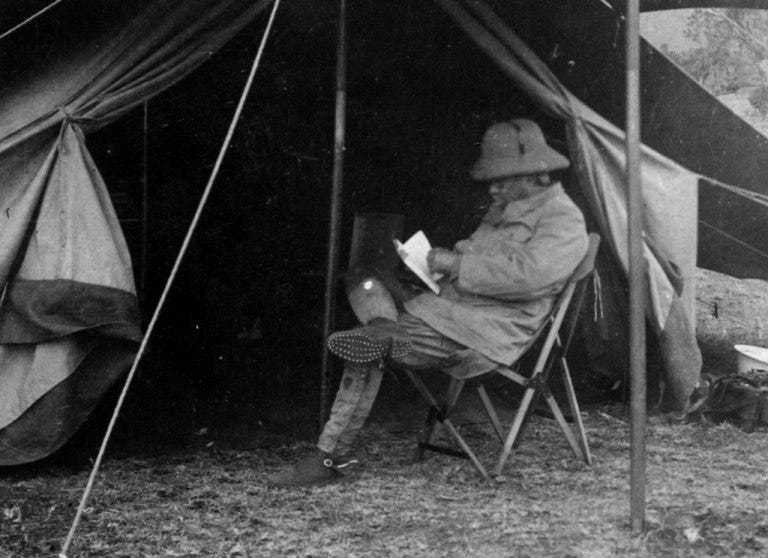
Even when exploring the Amazon, Roosevelt brought along quite the collection of books. Including St. Thomas More’s Utopia, and the last two volumes of Edward Gibbon’s Decline and Fall of the Roman Empire. When he sustained a leg injury on the expedition that became infected, causing him to suffer from terrible fevers, on the verge of unconsciousness, Roosevelt repeated the opening lines to Samuel Taylor Coleridge’s poem Kublai Khan.
“In Xanadu did Kubla Khan
A stately pleasure-dome decree
Where Alph, the sacred river, ran
Through caverns measureless to man
Down to a sunless sea.”
When not on perilous expeditions, Roosevelt enjoyed perusing his large, big game library at home, with countless books on hunting. He and his family also greatly enjoyed The Semi-Attached Couple, an English romantic comedy in the vein of Jane Austen.
Roosevelt loved to read to his children, always making the time to read to them, or to listen in while his wife did so. Reading them tales of adventure such as The Last of the Mohicans. He describes reading to his children as follows.
“If their mother was absent, I would try to act as vice-mother—a poor sub-stitute, I fear-superintending the supper and reading aloud afterwards. The children did not wish me to read the books they desired their mother to read, and I usually took some such books as Hereward the Wake, or Guy Mannering, or The Last of the Mohicans or else some story about a man-eating tiger, or a man-eating lion, from one of the hunting books in my library.”
Theodore Roosevelt enjoyed reading humorous poems to his children, one, Punkydoodle and Jollapin by Laura Richards, particularly appealed to him because of its lines about the President.
“Oh, Pillykin Willykin Winky Wee!
How does the President take his tea?
He takes it in bed, he takes it in school, He takes it in Congress against the rule.
He takes it with brandy, and thinks it no sin. Oh, Punkydoodle and Jollapin.”
In a letter, to his fifteen-year-old son, Kermit, he describes reading it to his youngest sons, Archie and Quentin.
“I read them Laura E. Richards’ poems, including “How does the President take his tea?” They christened themselves Punkeydoodle and Jollapin, from the chorus of this, and immediately afterwards I played with them on Archie’s bed. First I would toss Punkeydoodle (Quentin) on Jollapin (Archie) and tickle Jollapin while Punkeydoodle sprawled and wriggled on top of him, and then reverse them and keep Punkeydoodle down by heaving jollapin on him, while they both kicked and struggled until my shirtfront looked very much the worse for wear.”
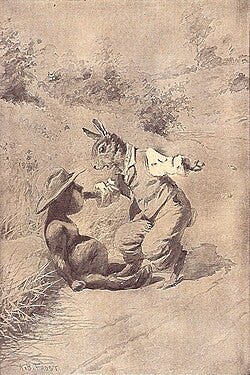
Roosevelt cherished Joel Chandler Harris’s Br’er Rabbit stories, which he would read aloud to his children, often mentioning the characters from the stories in letters to his children.
In a letter to his son Quentin, he wrote,
“The other day when out riding what should I see in the road ahead of me but a real B’er Terrapin and B’rer Rabbit. They were sitting solemnly beside one another and looked just as if they had come out of a book.”
Roosevelt wrote a letter to Harris, telling him that, “I have felt that all that you write serves to bring our people closer together… Your art is not only an addition to our sum of national achievement, but it has also always been an addition to the forces that tell for decency, and above all for blotting out of sectional antagonism.”
Roosevelt also invited Harris and his oldest son to visit the White House.
Finally, Roosevelt enjoyed the works of children’s author Kenneth Grahame, who sent him autographed copies of his works. After an initial dislike, Roosevelt came to love Grahame’s The Wind in the Willows, in a letter to Grahame, Roosevelt said the following:
“Mrs. Roosevelt and two of the boys… got hold of The Wind in the Willows and took such a delight in it that I began to feel that I might have to revise my judgment. Then Mrs. Roosevelt read it aloud to the younger children, and I listened now and then. Now I have read it and reread it, and have come to accept the characters as old friends; and I am almost more fond of it than your previous books. Indeed, I feel about going to Africa very much as the seafaring rat did when he almost made the water rat wish to forsake everything and start wandering! I felt I must give myself the pleasure of telling you how much we had all enjoyed your books”.
Roosevelt shared his great love of reading, with his children. It became a family affair.
Roosevelt, as you can see, was a prodigious reader. The books he read shaped and inspired him. He took the lessons from these books and turned them into action. As Roosevelt stated,
“I have always had a horror of words that are not translated into deeds, of speech that does not result in action.”
The ideas he gleaned from the countless times he read, were turned into strenuous action.
Though Roosevelt built a tremendous, voluminous library worthy of pride, it is appropriate to say that it was not his greatest joy, nor his greatest success. He was a lover of books, but they could not compare to that which he loved most, his children and grandchildren.
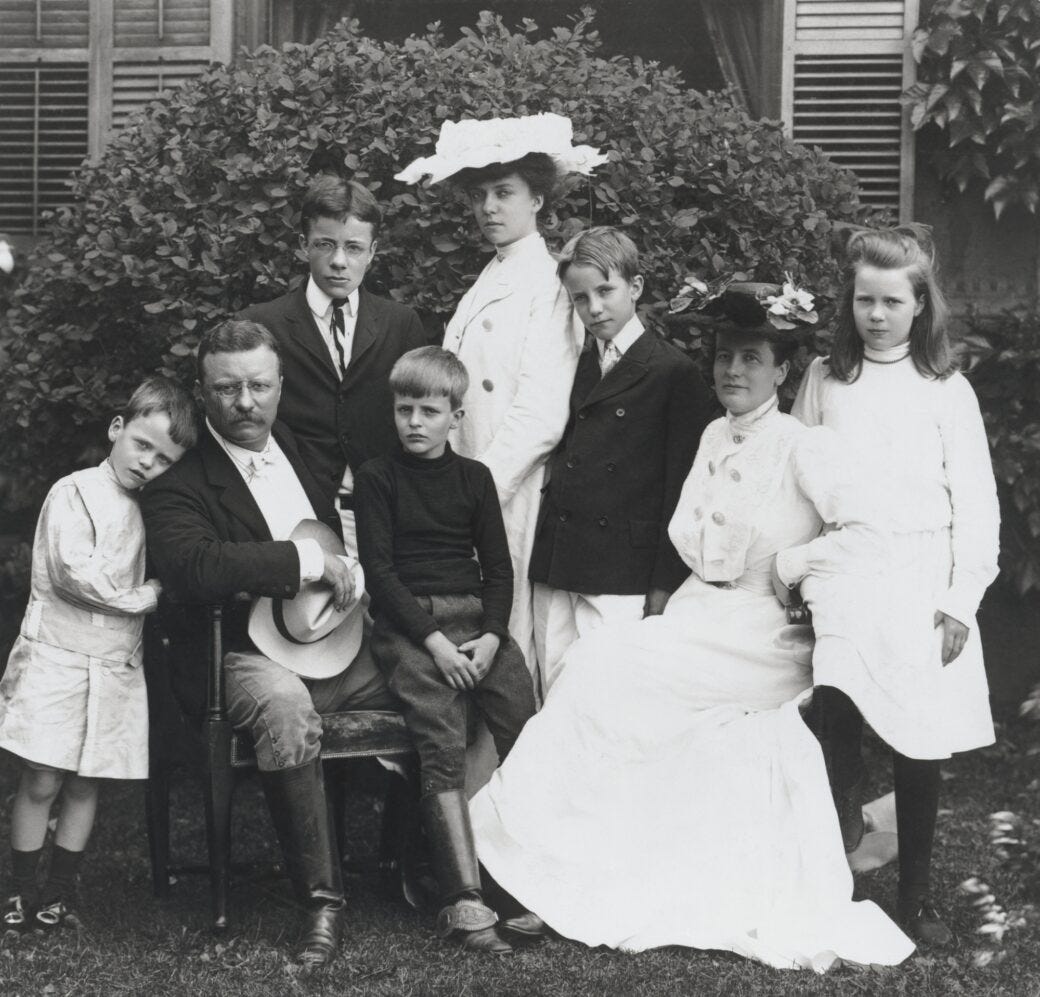
“Books are all very well in their way, and we love them at Sagamore Hill; but children are better than books. Sagamore Hill is one of three neighboring houses in which small cousins spent very happy years of childhood. In the three houses there were at one time sixteen of these small cousins, all told, and once we ranged them in order of size and took their photograph. There are many kinds of success in life worth having. It is exceedingly interesting and attractive to be a successful business man, or railroad man, or farmer, or a successful lawyer or doctor; or a writer, or a President, or a ranchman, or the colonel of a fighting regiment, or to kill grizzly bears and lions. But for unflagging interest and enjoyment, a household of children, if things go reasonably well, certainly makes all other forms of success and achievement lose their importance by comparison. It may be true that he travels farthest who travels alone; but the goal thus reached is not worth reaching. And as for a life deliberately devoted to pleasure as an end—why, the greatest happiness is the happiness that comes as a by-product of striving to do what must be done, even though sorrow is met in the doing. There is a bit of homely philosophy, quoted by Squire Bill Widener, of Widener’s Valley, Virginia, which sums up one’s duty in life: “Do what you can, with what you’ve got, where you are.”
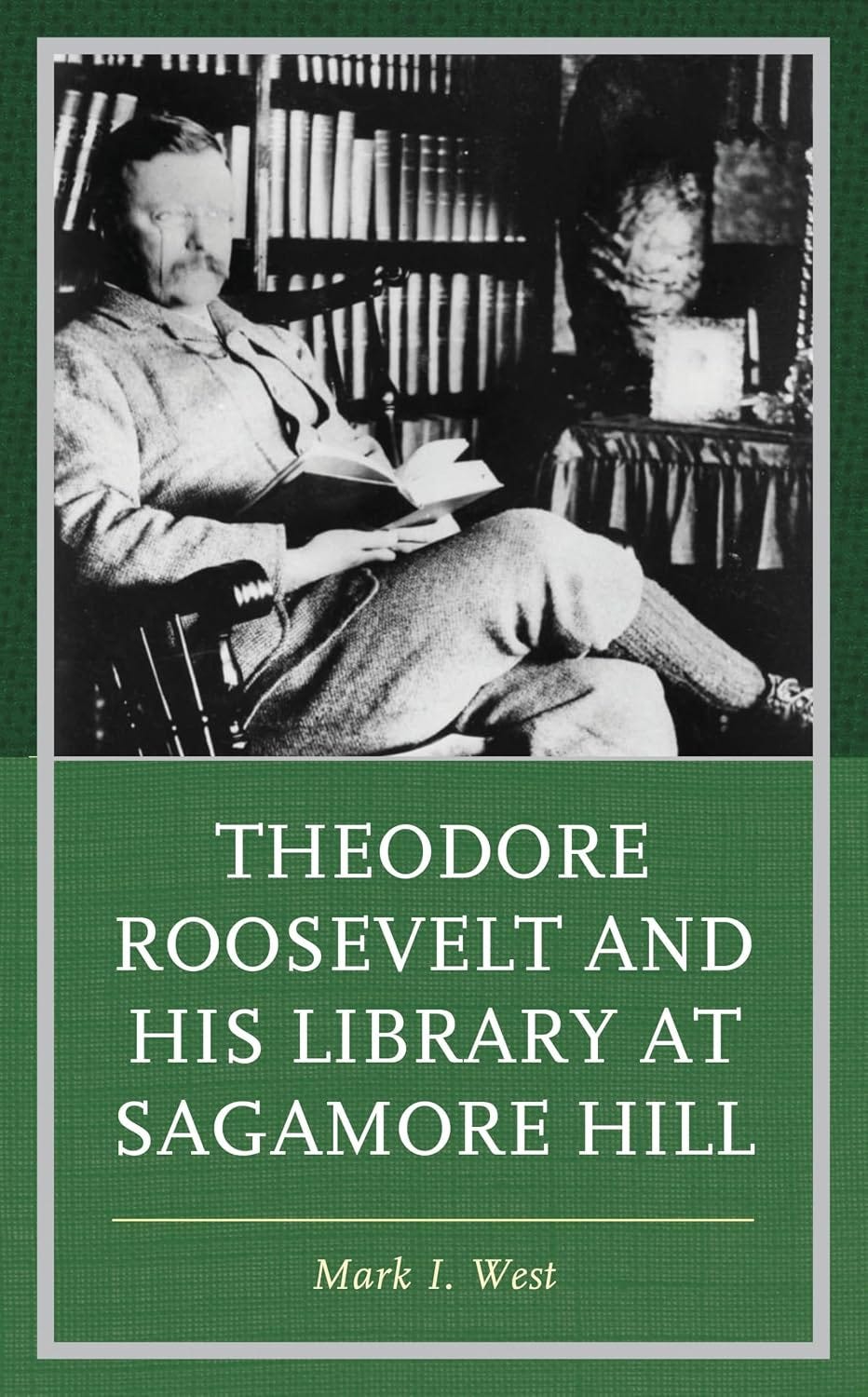
I owe much of the inspiration for this article to Mark West’s Theodore Roosevelt and His Library at Sagamore Hill, which I will link in the description. I also owe a great debt to Edmund Morris’s Theodore Roosevelt Trilogy, and to the countless writings of TR himself on the subject, in his autobiography and in other articles.
I’m Barbarian Herodotus, follow for more Masculine virtue.
Link to Theodore Roosevelt and His Library at Sagamore Hill (I receive a commission)
Link to Edmund Morris’s Theodore Roosevelt Trilogy (I receive a commission)